
PAST PROJECT
A Cedar Book, Coffee, Glasses, and Pen Holder
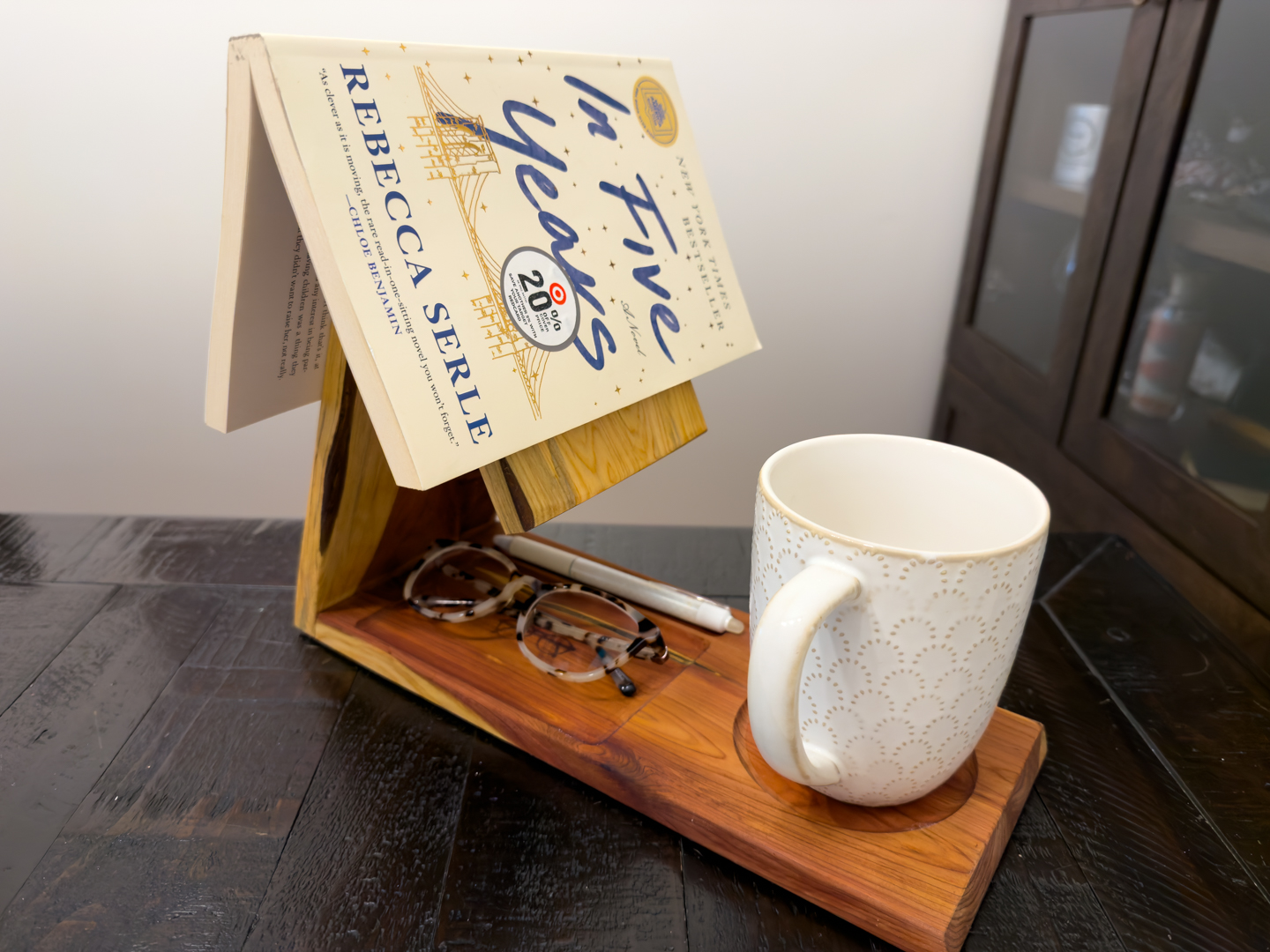
A Christmas gift for a friend who always has a book going, built to hold her place and keep a pen, her glasses, and her coffee cup within reach.
Wood: Cedar · Available as a custom order
Made For
A friend who always has a book going
Design
A folding book rest with cut-outs for a pen, reading glasses, and a coffee cup
Core Materials
Cedar
Techniques
Milling, CNC carving, laser engraving, hand finishing
A Christmas Gift for a Friend Who Always Has a Book Going
This project started as a Christmas gift for a friend who always has a book going. When Christmas came around, we wanted to give her something that meant more than a gift card, so we went looking for a project we could build just for her.
We found a design online for a simple book holder, something that props a book open and holds her place, and decided to build our version of it.
Once we had the basic form worked out, we didn't want to stop at just a book holder. Our friend always seems to have a pen or a highlighter nearby when she reads, along with her glasses and a cup of coffee, so we carved out a spot for each one right into the same board.
That small change made the whole piece feel different. A plain book holder just holds a book, but this one holds the way a person actually reads, the book, the pen or highlighter used to mark a page, the glasses, and the coffee that usually arrives somewhere in the middle of a chapter. It is the difference between a piece that could sit on any shelf and a piece built for one person's desk.
That is the heart of a good gift. It starts with noticing what someone enjoys and building something around that, not reaching for a one-size-fits-all item off a list. This one was small and cheap to make, but the effort of fitting it to her was the part that mattered.
Finding a Design Worth Adapting
We don't build from scratch every time. For this one, we found a similar book holder design online and used it as a starting point, then changed it to fit what our friend actually needed at her desk.
A plain book holder felt like it wasn't quite enough of a gift on its own, so we decided to build in a spot for a pen or highlighter, her glasses, and her coffee cup, all carved into the same board as the book rest.
Adapting a design this way is the practical part of custom work. The base form does the hard thinking for you: it already holds a book open and keeps a page in place, so we did not have to solve that from nothing. What we did on top of it was small and specific, deciding where each recess went and how deep it had to be, and making sure the cup did not sit loose and the glasses did not tip. A good starting point lets you spend your time on the details that make the piece yours instead of the basics everyone else already figured out.
The trick is to keep the original design where it works and change only what you need. Here that meant leaving the folding book rest alone and carving three new pockets into the base. It is an easy idea to overcomplicate, and the piece stays honest only when each change earns its place.
Milling and Cutting the Cedar
We started with rough cedar boards and ran them through the thickness planer to get them flat and even, then squared up the lengths and angles on the miter saw. From there we worked through the grits by hand, sanding from 120 all the way up to 400 so the board would feel smooth wherever our friend's hand landed on it.
Once the board was flat and sanded, it was ready for the recesses that would hold everything else.
Getting the wood ready is where the piece either shows a lot of work or hides it. Rough lumber arrives warped and uneven, so the planer sets a true, even thickness that everything else can depend on. Cutting to length on the miter saw keeps the board square, and a square board is the only kind that folds flat and stands up straight. A wobbly base would make the book tip, so this step is not housekeeping, it is the foundation.
The sanding takes the longest and is the part people underestimate. Moving from 120 up to 400 grit in order smooths out the marks each coarser grit leaves behind, and cedar takes it well. Because this piece sits under a hand while someone reads, we sanded the flat faces and the folds extra carefully. The finish you see later depends on the surface beneath it, and a smooth base is what makes the wood feel as good as it looks.
Carving the Recesses
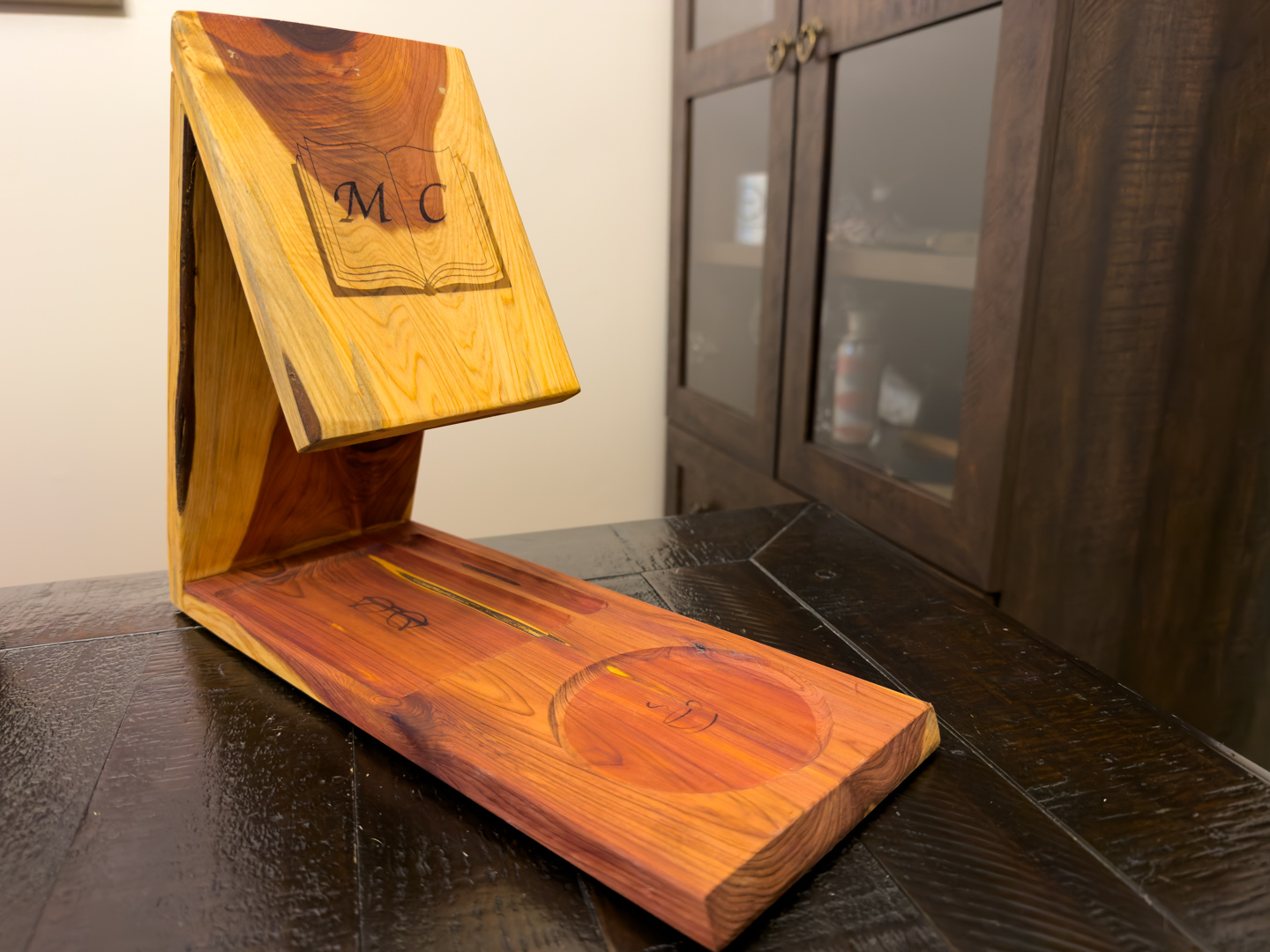
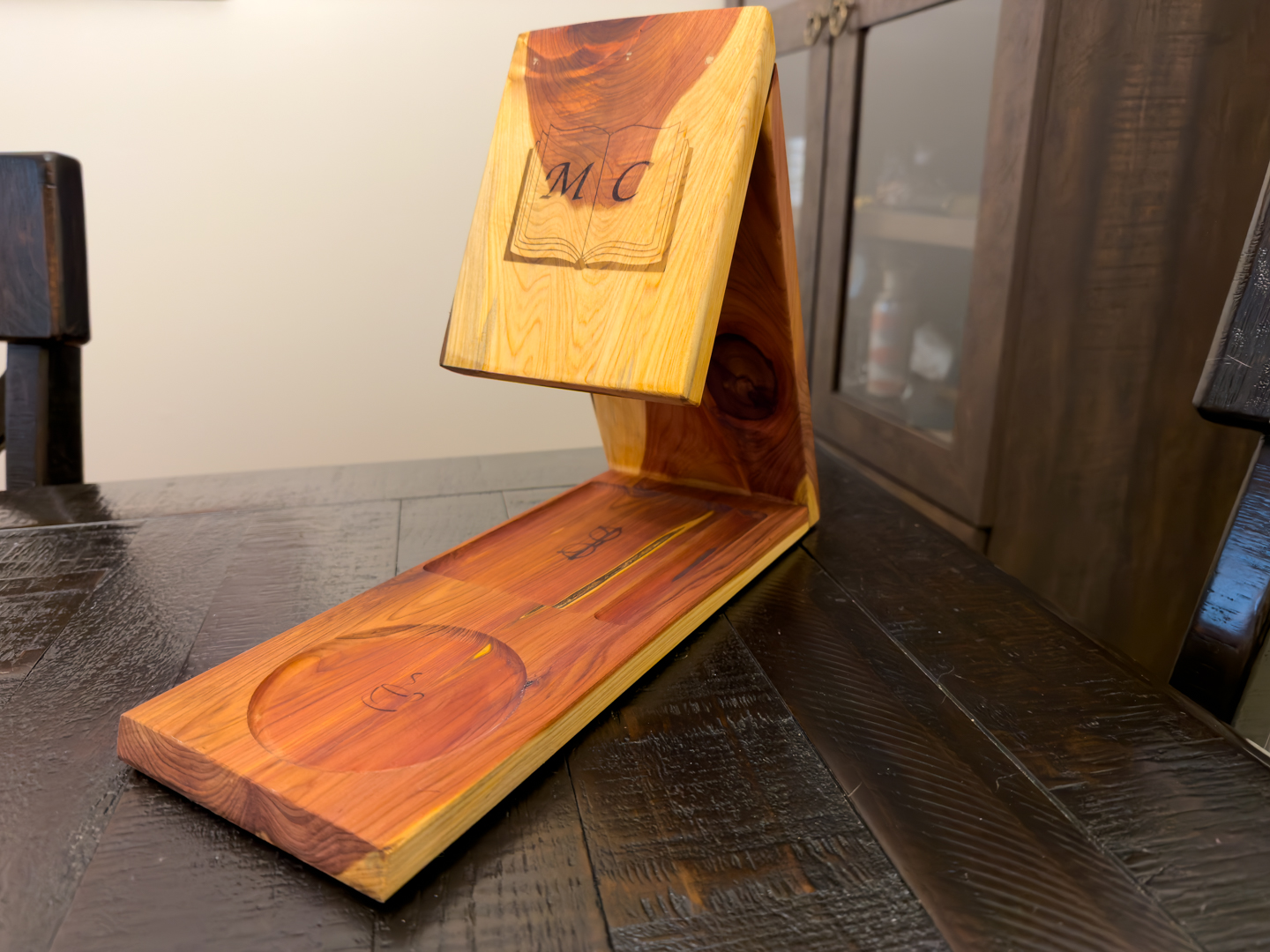
With the board milled and sanded, we used a computer numerical control (CNC) machine to carve out the recesses for the pen or highlighter, her glasses, and her coffee cup. The CNC let us get clean, consistent pockets sized to the actual objects rather than eyeballing it by hand.
The book rest itself stayed simple, cut and shaped so it folds from the same board and keeps a book open to wherever she left off.
That is why the machine was the right tool for this job. Carving three different-sized pockets by hand is possible, but keeping them even and square is a slow fight against drift. The CNC holds the position, so each pocket lands where it should and at the depth it needs, which means a cup sits without rocking and a pair of glasses does not slide out. Clean pockets are the quiet part of the piece that a buyer never notices until they try the item.
Sizing the pockets to the real objects matters more than it sounds. A cup recess that is too shallow or too wide leaves a gap, and a glasses cradle that is too tight will not take them off easily. We cut to the sizes that fit the things she actually uses, which is the kind of fit that turns a generic tray into something made for her desk.
Assembling with Glue and Pin Nails
With the recesses carved and the book rest cut, we assembled the piece with Titebond III wood glue and pin nails to hold everything solid while the glue set.
For the finish, we applied Walrus Oil Furniture Butter, which brought out the color and grain in the cedar without leaving a heavy film on the surface.
Gluing this kind of joint means patience. The pin nails do not carry the weight on their own, they just hold the parts in place while the glue does the real work, and the glue needs time to set undisturbed. Rushing that step is how a joint loosens later, so the piece stays clamped until it is fully cured.
Finishing is where cedar shows itself. Cedar is naturally warm in color and holds its grain in a way that an oil brings right to the surface. A heavy film would sit on top and flatten the look, so an oil like this one soaks in and leaves the wood feeling like wood, not like it is painted over. That is a big part of why we finish these pieces with oil instead of a thick coating.
Switching to the Laser for the Engraving
For the engraving, we switched over from the CNC to a laser and used Lightburn software to lay out the artwork. We engraved her initials on the book rest and added small icons above the pen, glasses, and coffee cup recesses so each spot is obvious at a glance.
We ran the laser at a low power setting and went over the artwork twice, which gave the lines just enough depth to hold a soft shadow along the edge without burning the cedar around them.
The CNC does the heavy carving, but fine lettering and small icons are a job for the laser. Lightburn gives us the layout, and the laser cuts clean, sharp lines that a bit would struggle to hold at that size. Doing the pass twice at low power is the key. One pass can leave a line too light to read, but a single hard pass can burn the wood and leave a dark halo around the letters. Two gentle passes let the marks sink deep enough to hold a shadow, and they keep the edges crisp, with no scorching around the letters.
The small icons do real work. A cup recess is easy to read, but a spot for a pen or a pair of glasses is not, so the little marks above each one tell you what goes where without anyone having to guess.
The Finished Piece
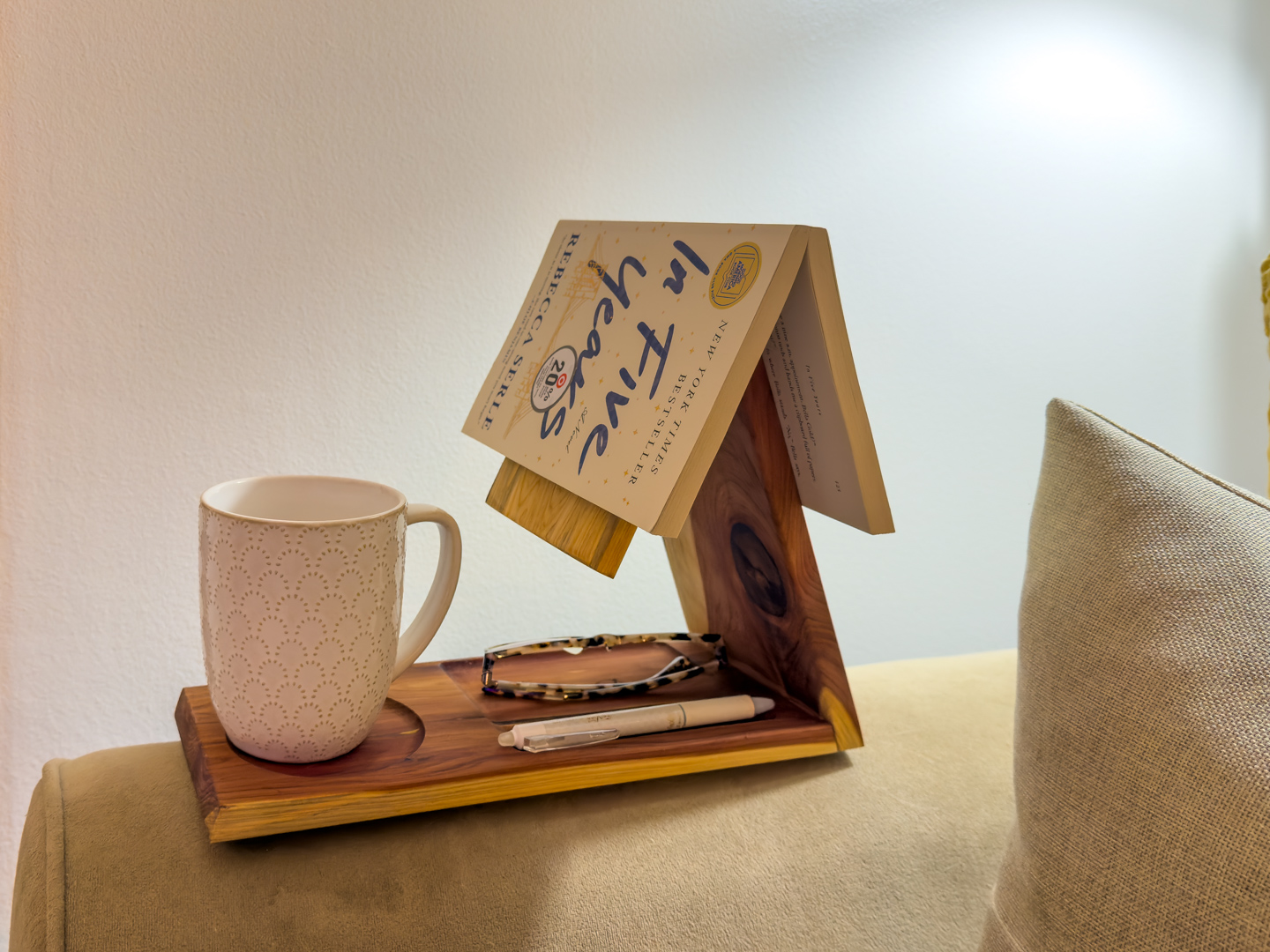
Our friend unwrapped it on Christmas morning, book, pen, glasses, and coffee cup all with a place of their own. This one was built for her, but the design works as a custom order sized and detailed for whoever it's for.
Why Cedar for a Reading Holder
Most of the pieces we make for reading and desk use start with cedar, and this one is a good example of why. Cedar is light enough to carry around, which matters for something meant to move with a book from a chair to a shelf and back. It is also naturally warm in color, so a finished piece reads as inviting on a desk rather than cold and grey.
The grain on cedar tends to run in clear lines, and an oil finish pulls those lines right to the surface, which is why the piece looks better the more you look at it. Cedar also takes engraving and carving cleanly, so the recesses and the lettering hold their shape and their edge. For a gift that someone will actually use every day, that combination of light weight, warm color, and clean detail is hard to beat.
Finishing Cedar with an Oil
We finish cedar with an oil like the Walrus Oil Furniture Butter used on this piece, and the reason is simple. Cedar is an open-grained wood, and an oil soaks into the grain and colors it from inside out, whereas a heavy film just sits on top and flattens the look.
An oil finish also keeps the piece easy to live with. It does not crack or peel the way a thick coating can, and when it dulls after a while, a small top-up of oil brings the color back instead of needing the piece stripped and refinished from scratch. For something that sits on a desk and gets used constantly, that low upkeep is part of why an oil is the right choice here.
One thing worth knowing: oil does not seal out spills the way a thick coating can. A ring from a wet cup can still mark cedar, so it helps to lift a hot or damp cup off the wood and wipe up a spill when it happens. Done that way, the finish holds up well year after year.
Caring for the Piece
A cedar piece finished with oil wants very little, which is one of the best parts of owning one. The main job is keeping moisture off the wood. Wipe up a spill when it happens, and try not to leave a wet or hot cup sitting on the finish, since that is what leaves a ring. Cedar drinks water, and a ring is just water that got in before you could wipe it.
When the color goes dull, rub a little oil into the surface with a clean rag and the wood lights up again. There is no need to strip and refinish the whole piece for that. Keep it away from a sunny window, since the light in a bright spot will pull the warm color out of the wood over time.
Cedar and an oil finish mean a piece that ages instead of wearing out. The more it is used, the more the finish settles in, and with a little care it keeps looking good for a very long time, which is exactly what a gift is supposed to do.
Materials and Tools Used on This Piece
- Cedar boards, used for the book rest and base
- DeWalt thickness planer, used to flatten the rough boards
- DeWalt miter saw, used for length and angle cuts
- Sandpaper, worked progressively from 120 to 400 grit
- CNC machine, used to carve the recesses for the pen, glasses, and coffee cup
- Laser engraver, used for the monogram and icons
- Lightburn software, used to lay out the engraving artwork
- Titebond III wood glue, used for assembly
- Pin nails, used to hold the assembly while the glue set
- Walrus Oil Furniture Butter, used for the final finish
Why This One Mattered
A useful gift starts with noticing what someone enjoys. This holder brings a book and the little things that go with it together in one place.
A version of this is available to order. See the cedar holder listing.
See the current listing for the starting price and personalization, or contact us to order.
Personalizing a Reading Holder
The best thing about this design is that it is built to be made for one person, and that is the part that turns it into a gift. The base stays the same, a cedar board with a folding book rest and carved recesses, but the details change to fit whoever it is for.
Names and initials are the simplest way to do it. We engrave a name or a set of initials on the book rest, and small icons above each recess show what goes in that spot, so a pen, glasses, or a cup has a clear home. For a reader, that kind of personal touch is the difference between a piece that looks like it came from a store and one that looks like it was made for their desk.
Before we build, we confirm the size and the cup fit with the person ordering. A different cup or a smaller desk changes the layout, so getting that right up front is what makes the finished piece fit. Cedar also varies in color and grain from board to board, so each holder has its own character, and that is a good thing. No two come out the same, and the one that lands on your desk will be yours alone.