
Made around your idea
Custom Work
A gift with a personal message, a display that fits your collection, or a piece you've pictured for your home. Tell us what you have in mind. You don't need a finished drawing to get started.
Tell us a little about it
Share what the piece is for, its rough size, and any wood, color, or engraving you have in mind. Photos or sketches help us understand the look you like.
Include your budget, any target date, and your city and ZIP code. We'll ask for anything else we need.
What we can make
The shop builds signs, plaques and awards, cutting boards, serving pieces, wall art, displays for coins and desks, personalized gifts, and outdoor pieces. We pair the wood with CNC carving, laser engraving, epoxy resin, and 3D printing to add lettering, color, and one-off detail that would be hard to cut by hand. Each tool covers a different task, and we pick the one that suits the piece rather than pushing a single method onto every order.
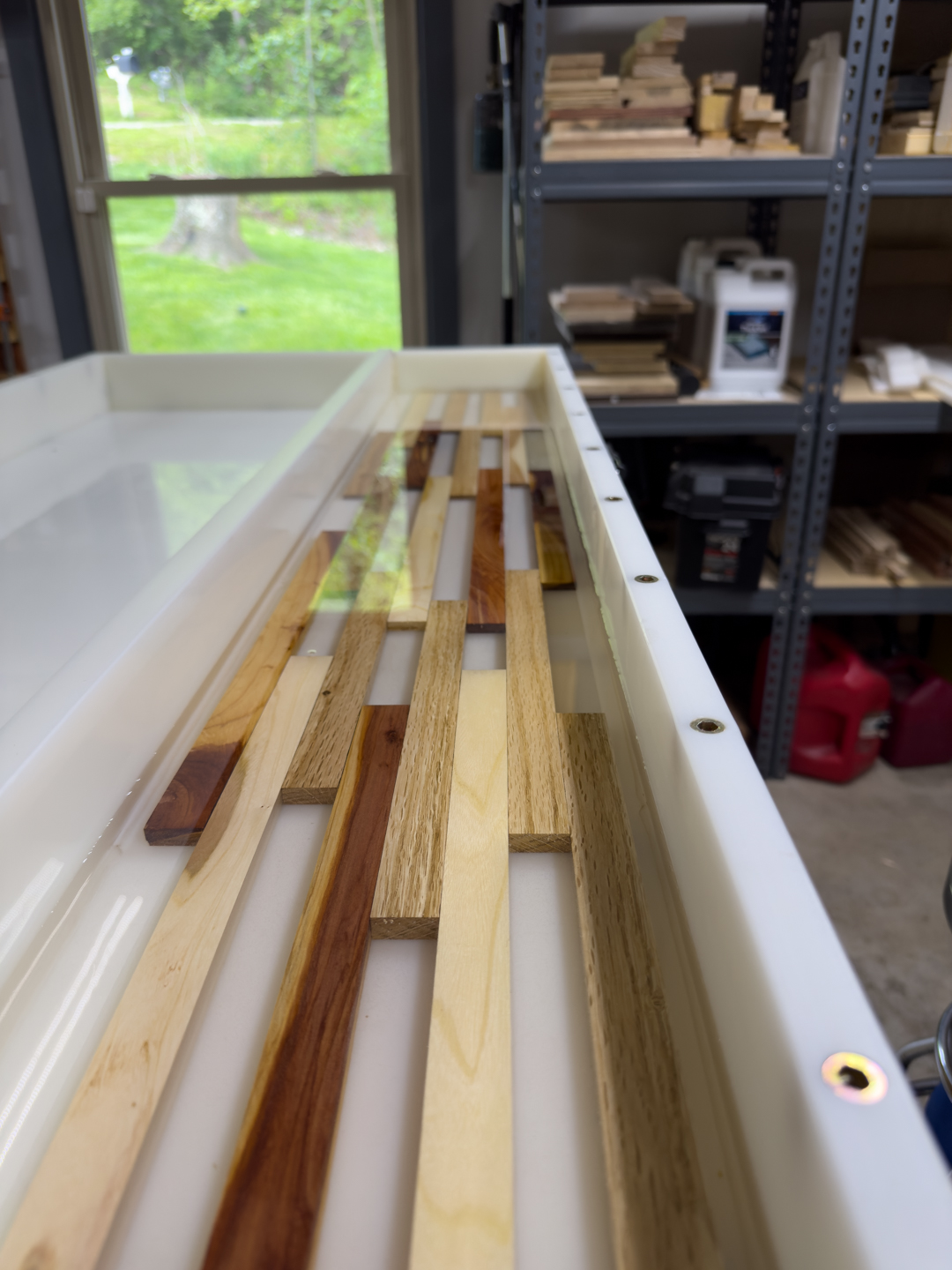
Wood strips of several kinds laid out in the shop, ready to be matched to a piece.
A few things to know
- We source the lumber for our work and don't accept customer-supplied lumber.
- Very large pieces, unsafe designs, or work we can't deliver or ship safely may be outside what our shop can take on.
- Artwork, logos, and insignia are reviewed individually and may need proof of permission.
- We don't accept hate-based or racist content.
- Repair and refinishing requests are considered individually.
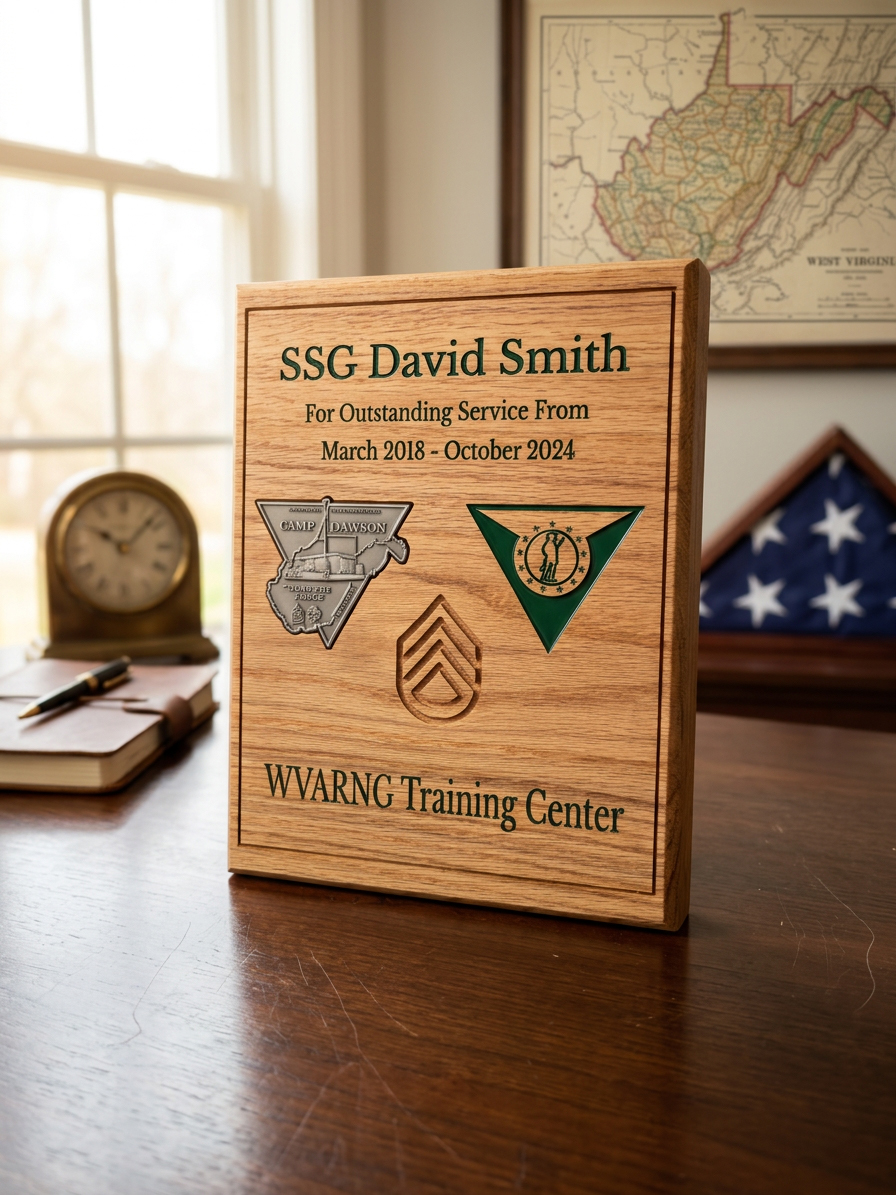
A finished award plaque, engraved and standing on a desk, one of the pieces we build to order.
From idea to finished piece
Send us a note and we usually reply within one to three business days. When a project is a good fit, we write back an estimate that lays out the design, the cost, the time to build, the payment terms, and the route the piece will take to reach you. The full step-by-step of ordering lives on our Contact page, and the timing, deposit, and payment rules are spelled out on the FAQ and policies page.
Before you approve the piece, we work through reasonable design changes together. After the build starts, a later change can cost more or add time, so we flag that up front. Any initial payment is settled in the estimate, and the balance falls due before the piece leaves the shop unless your accepted estimate says something different.
A simple board is usually ready in a few days. Larger or more detailed work, and any piece built in layers of epoxy, takes longer because each pour has to harden before the next one goes on. We confirm the timing for your order in writing.
What a quote includes
Your reply is a written estimate, not a bare number. That document lays out the design, the price, the time to build, the payment terms, and the route the piece will take to reach you, and it is a fair way to check whether the build fits your plan before you commit.
The estimate is also what keeps both sides honest. It locks the design so neither of us is guessing, it fixes the price and the timing so nothing is a surprise, and it states when payment falls due. When a piece is layered or detailed, the estimate notes that the build runs longer than a plain board, since resin must cure between pours, and the date we give you in that document is the one we commit to unless your accepted estimate says something different.
When the idea needs a small adjustment before it can be built, we raise it in the estimate instead of assuming. That is how the finished piece stays the one you pictured, and it is the reason we send written terms rather than a quick answer. When you are ready, approve the estimate and we begin.
Choosing the right wood
For most pieces, wood is the main material, and the species you pick decides how the finished work looks, feels, and holds up over time. We buy the lumber for every job, so there is no board to find, flatten, or square on your end. In the shop we select a piece for the color, grain, and strength the project needs, and we mill it flat and true before any carving or engraving begins.
Dense hardwoods such as oak, maple, and walnut suit signs, plaques, and serving pieces because they take a clean edge. Oak is a good partner for epoxy, since it grips the resin well and shows a bold grain that reads across a large board. Maple stays pale and tight-grained, which works when a nameplate or board should keep a light, even tone. Walnut runs warm and dark, and it suits awards and display pieces where the wood itself is the main visual. Lighter woods and cedar, by contrast, suit pieces that sit on a desk or shelf and want a warmer feel without the weight of a heavy hardwood.
Grain direction decides how a piece looks and how it wears. Wood shifts with the humidity in the air, and how that shift shows depends on the way the boards were cut and joined. When we plan a board we read that movement so the finished piece does not crack or warp as the seasons turn. For a piece that lives in a room where the temperature and moisture change, we finish it so the wood can move rather than trapping it in a hard shell. An oil finish, such as a paste wax or a tung oil blend, soaks in and keeps the wood moving, which is why a desk organizer or a cutting board finished with oil wears better over the years than a thick plastic film would.
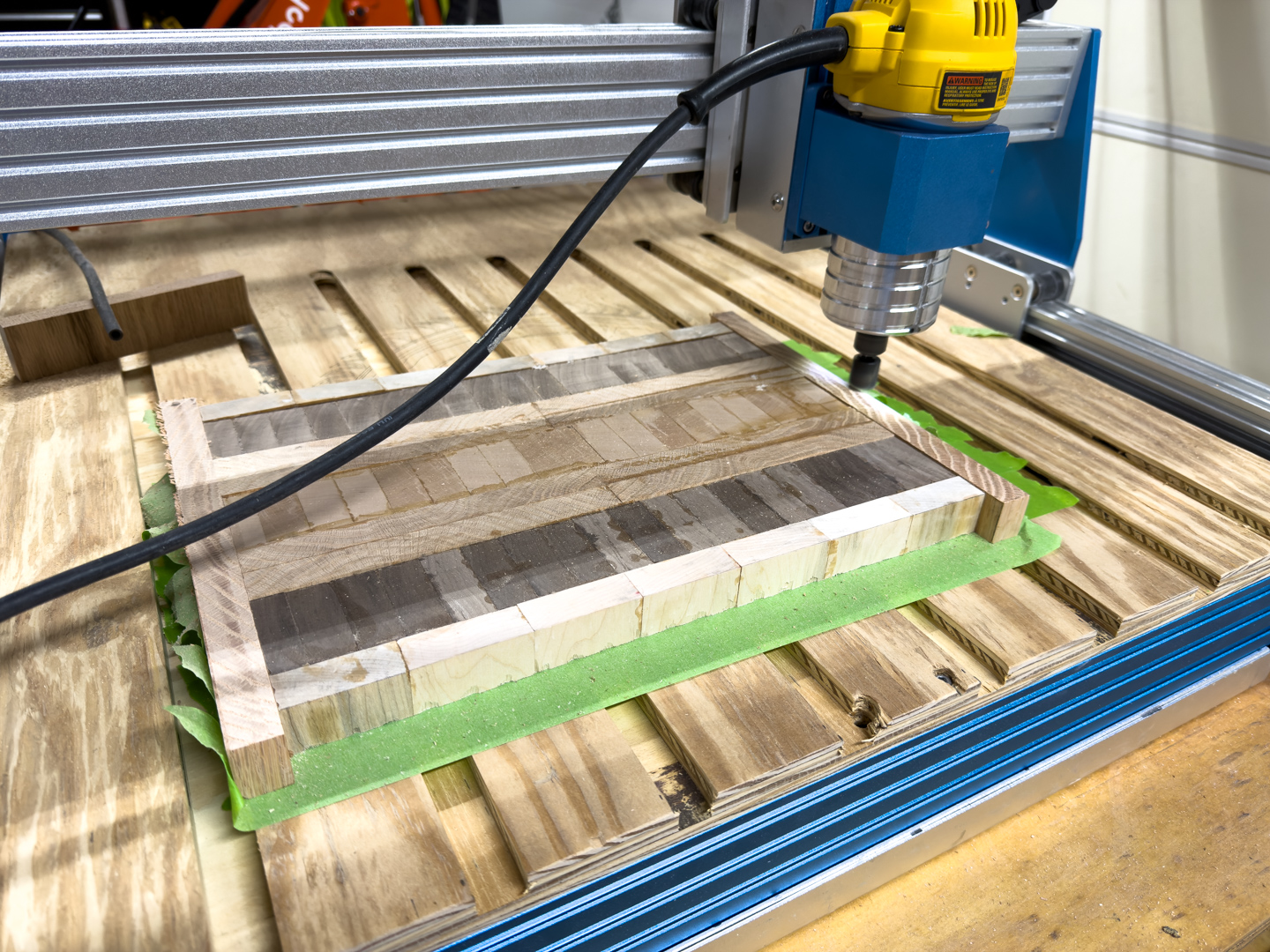
A CNC router cutting a pattern into a wood panel, one of the ways we add detail a hand tool would miss.
If you have a wood in mind, tell us, and we will say plainly whether it suits the piece you have pictured or whether a different board would be the better choice. We don't take customer-supplied lumber, so the piece you receive is one we chose and prepared, and that keeps it consistent with the rest of the work we ship.
Finishes that last
A finish guards the wood and pulls out its grain, and it is the first thing a hand touches, so we take the time to get it right. On most pieces we use a paste wax or an oil blend that soaks into the wood and leaves a soft sheen. That kind of finish is easy to keep up, it won't leave a hard shell that chips or peels in use, and it stays repairable, so a small scratch or ring can be rubbed out later rather than becoming a permanent mark.
Epoxy resin is both a finish and a design tool. When we pour it, we are not just sealing the wood, we are building part of the piece. Tinted layers add color and depth that a stain or dye can't reach, and the resin can hold a printed letter or a small object set into it so the detail reads as part of the material instead of something glued on. On a desk nameplate or a coin display, that means the lettering and the color become part of the surface rather than a label on top of it. The cost is time: every layer of resin has to cure fully before the next one goes on, and a thick pour can take a few days between steps. That is why a layered piece runs longer than a plain board, and we confirm that timing in writing before you approve the order.
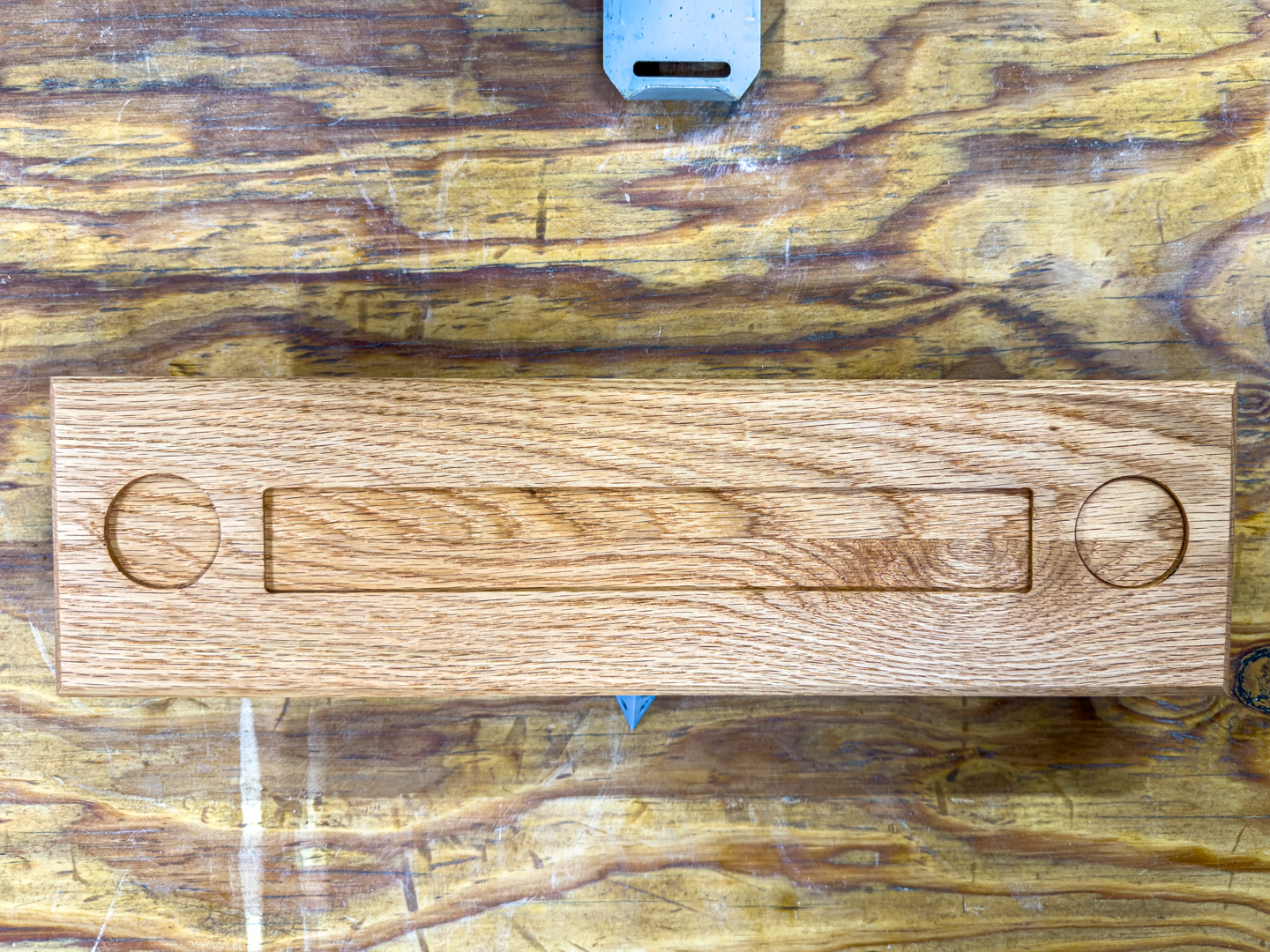
The oak base of a nameplate, with the recesses cut for the resin block and a pair of coins.
A cutting board and other food-contact pieces get a food-safe oil, never a wax that sits on the surface, and we build food pieces apart from display pieces so each is protected the right way. The upkeep for each differs, and we tell you which one you are buying and how to care for it. A cutting board wants to be dried after each use and kept away from standing water, while a display piece mainly needs to stay clear of direct heat and strong sunlight so the finish keeps its look.
Caring for your piece
Most of the pieces we make are meant to be used, not kept behind glass. A cutting board, a serving tray, a desk organizer, and a wall sign each need only a little attention to stay good-looking for years, and the right amount of care lets a piece age in a way that looks intentional rather than worn out.
For a cutting board or serving piece, dry it after each wash and keep it out of standing water. A long soak pulls moisture into the end grain and can warp it, so a quick rinse and a towel dry beat a full bath. Put a food-safe oil back on when the surface looks dry, usually a few times a year depending on how much the piece is used. Keep it out of the dishwasher, which strips the finish and can split the wood. A small ring or scratch can be rubbed out with a light oiling, so the piece stays smooth without a sanding.
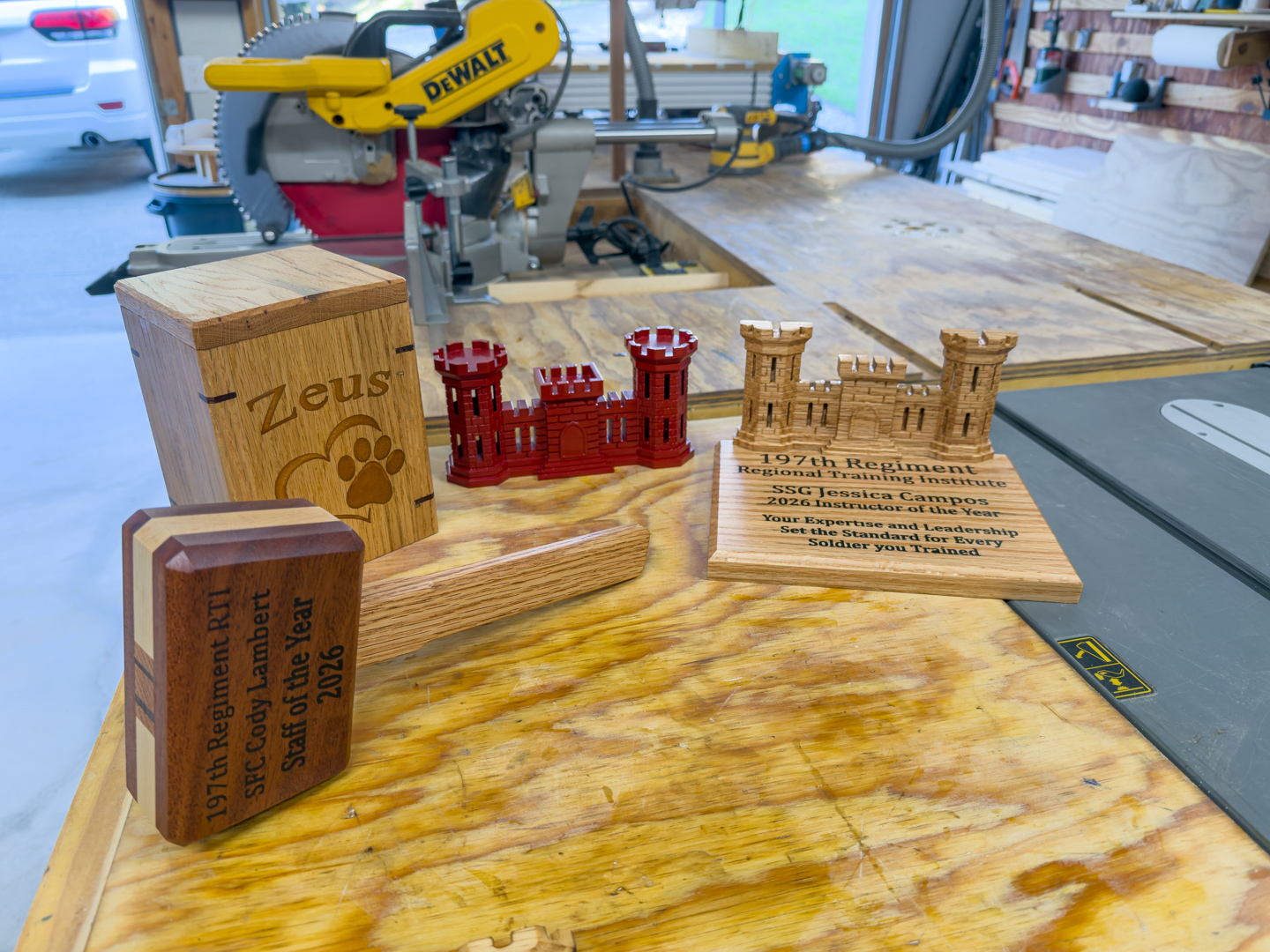
Engraved wooden award plaques resting on a shop workbench, the kind of pieces we build to order.
For a display piece, a desk organizer, a wall sign, or an outdoor piece, the main risks are heat and sun. Direct sun can fade the grain and dull the finish, so keep the piece out of a direct window when you can. Wipe dust and spills with a dry cloth and steer clear of harsh cleaners that can strip the finish. For an outdoor piece, the wood is treated to weather, but a periodic reapplication of the finish keeps the protection in place and slows the wear. A little care goes a long way, and when in doubt, keep the piece clean, dry, and out of direct heat.
Personalizing the piece
A custom piece is your chance to make it yours, and personalization is where that shows up. We add names, initials, short messages, and small icons that make the piece fit the person or the moment.
On a desk organizer or a reading holder, a name or initials can sit near the top, with small icons above the carved pockets for a pen, a pair of glasses, and a coffee cup so each spot stands out at a glance. On a nameplate, a name and a chosen color work into the design, with recesses cut for two challenge coins set into the base and a short message worked into the underside that stays hidden from everyone but the person using it. On a sign or a wall piece, a message or a small logo can carry the piece, and on an award, a name, a date, and a line that names the achievement all fit into one board.
We can also tie a piece to a color scheme or a theme. A thin blue line, a favorite team color, or a soft family tone can be worked into the wood or the resin so the piece feels part of the room it sits in. For a gift, that kind of matching is what turns a wooden board into something that feels made for one person, and it is a detail we take time to get right.
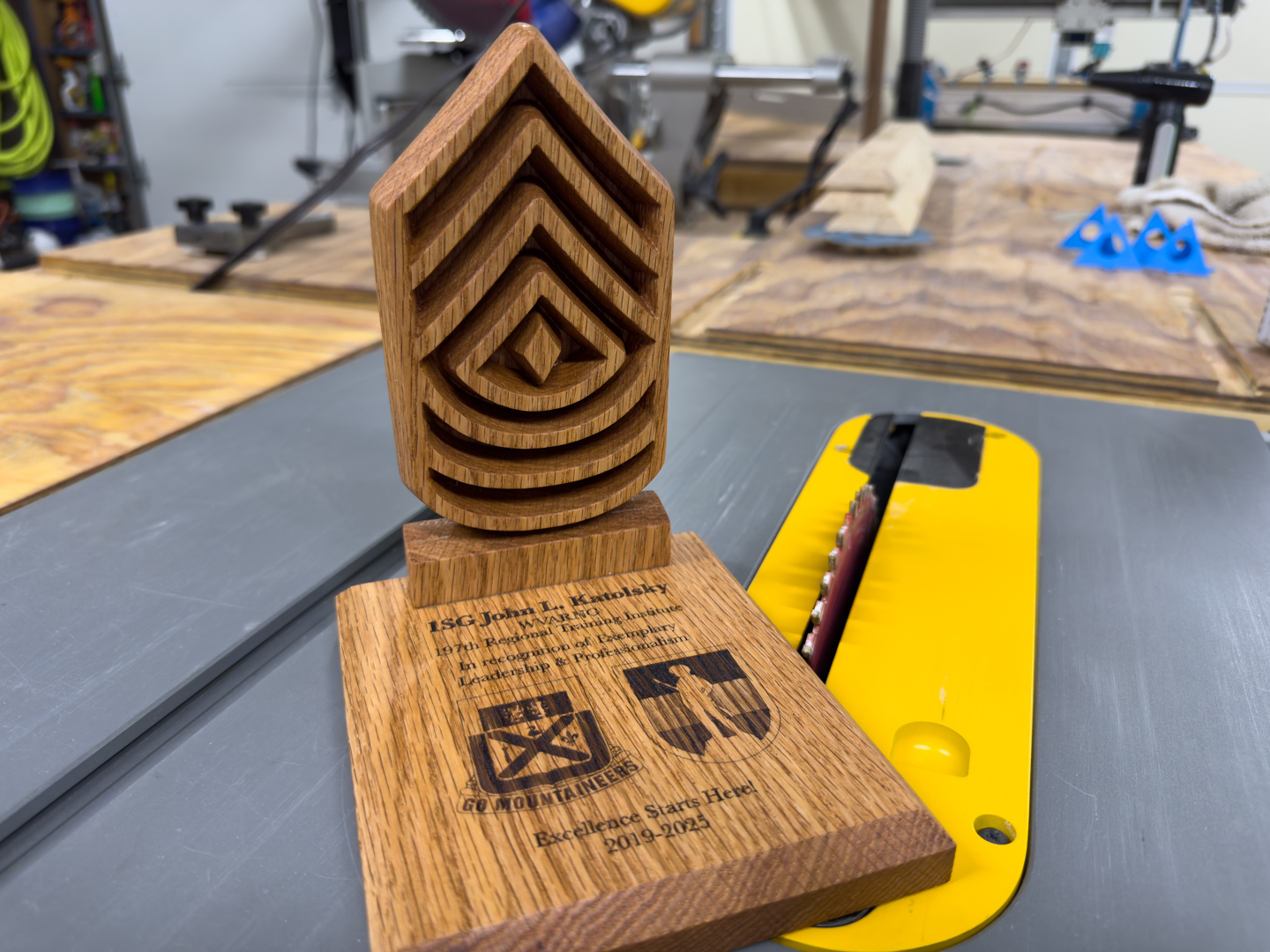
A carved wooden award trophy with three chevrons and an engraved base.
When you begin an order, tell us what you want on the piece and send a photo or a sketch if you have one. We'll confirm the exact lettering, colors, and final dimensions with you before we build, so the piece arrives the way you pictured it. We work through reasonable changes before you approve the design, and any artwork, logo, or insignia is reviewed on its own, since some requests need permission before we can put them on the piece.
Ideas for a gift or a milestone
Custom work makes a strong gift because it can be built around one person and one moment. The point of a made piece is that it fits the person who will use it, not just the moment it is given for. That is the gap between something built for you and something pulled off a shelf.
For a reader, a desk piece with a pocket for a book, a pen, and a cup is a small comfort reached for without thinking. For a desk that wants a personal mark, a layered nameplate carries a name and a chosen color, and its recesses hold two challenge coins for the person who uses it. On a wall, a sign or a display piece can carry a message or a small logo, and for a group that earned something, an award board can hold the name, the date, and the achievement.
We can build a version of the pieces you see in our project stories, or something new around your idea. Each piece is made for you, so the wood, the resin, and the small handmade touches will differ from any example you see. That is the point of a custom piece: it is yours. When you are ready, send us the idea and whatever details you have, and we'll go from there.
Delivery and shipping
On an accepted order of $75 or more, we may offer free local delivery out to 25 miles from Charleston. A smaller order can ride along too, when we can fold its drop into a trip we're already making.
We don't offer customer pickup or workshop visits. Shipping and packaging costs sit in your listing or written estimate.
Let's get started
Send us whatever you have and we'll take it from there.