
A private shop, a maker's patience
About the Shop
Small custom work, built for the people who asked for it.
How we started
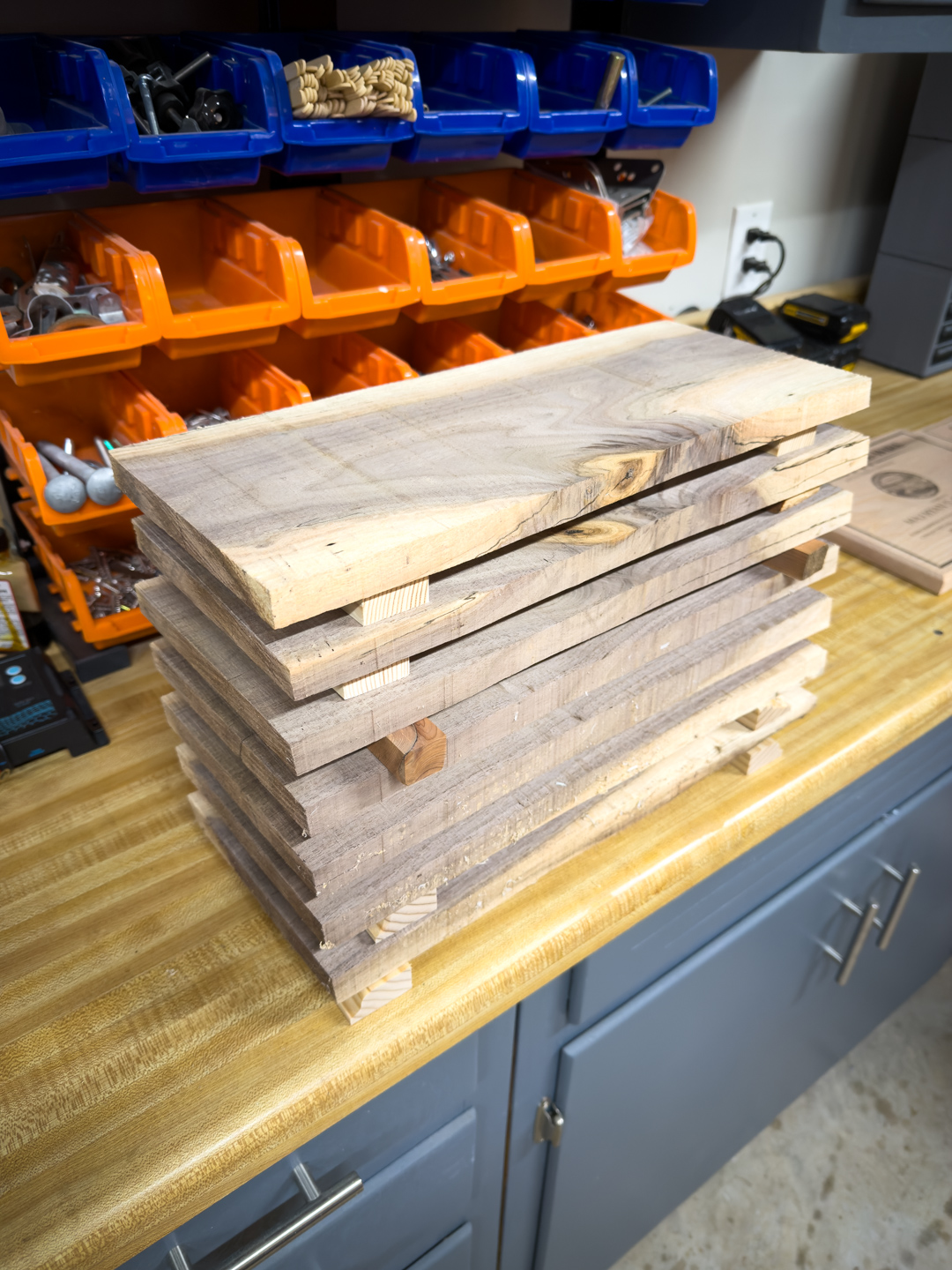
Boards clamping on a shop bench, waiting for the glue to set and the wood to settle.
Our owner began as a hobbyist with a hand tool in a small corner of a garage. The first pieces were things he needed and then things people around him wanted. What started as a way to spend weekends became a small practice that still grows one finished piece at a time.
The name of the shop comes from that beginning. Vern is the founder's family nickname, and the spirits are part of how the shop started, a nod to the quiet after-hours hours when a piece got finished after the rest of the world had gone to bed. The work never promised to be a business. It just kept coming, one order at a time, and every piece still gets the same attention it did on the first day, because that is how we keep the work honest.
That is still how we work. When you order a piece from us, you are not buying from a catalog or a warehouse. You are asking a person to make something for you, and we treat that the way you would want someone to treat a piece of yours. We take the time to get the details right, and we keep the shop small enough that the person cutting the wood is the person you are talking to.
What we believe
Wood is not plastic. It is alive, and it will move, wear, and age. We design for that, not against it. A good piece should last and look better with use, not hide behind a coating that pretends it is something it is not.
We also think a shop should be small enough that you can talk to the person making your piece. When we say a quote, we mean it. When we say a date, we plan for it. We would rather tell you a piece will take the time it takes than promise something we cannot keep. A date we confirm in writing is a date we plan for, and if anything changes on our end, we tell you before it matters to your plans.
Wood is a material that has been used for everything from tools to houses, and it keeps its value for a reason. A solid piece of wood, cut and joined well and finished to suit how it will be used, can outlast the person who ordered it. It will wear the way things wear, taking on a patina that a factory piece never will. That is not a flaw to fix. It is the point of working in wood instead of plastic or metal. A reading holder that has sat on a bedside table for ten years, a cutting board that has seen a hundred meals, a desk nameplate that has been read every morning, these pieces carry the marks of being used. They were made to be used, not to sit behind glass or behind a coating that hides the wood.
Because wood moves with the seasons, we build pieces that give it room to do that without splitting. We choose our joints and our finishes for the life a piece will live, not just for how it looks the day it leaves the shop. A piece that will sit in a warm room by a window needs a different finish than one that will live in a cooler corner, and we talk that through with you when it matters.
Who we work with
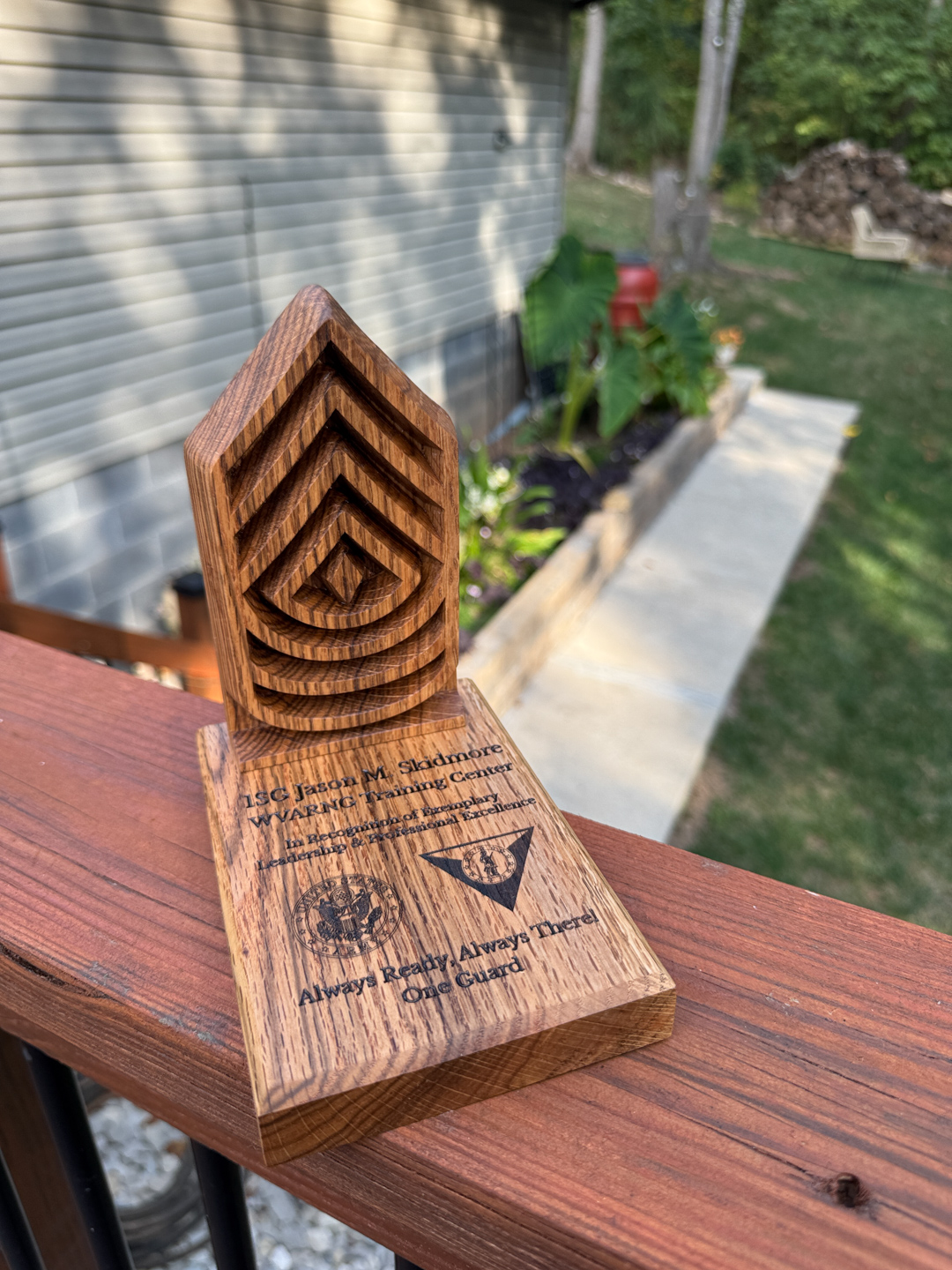
A wooden award plaque, made for a First Sergeant (1SG), standing on an outdoor deck railing.
The pieces we have already made reach a range of people and uses. A desk nameplate carries a name for one person, a wall flag marks a spot on a wall, a display holds a collection, and a cutting board has to stand up to real cooking. Some ask for a name on a desk, some ask for a flag for a wall, and some ask for something they could not picture until they saw it.
Each piece is a little different, and that is the point. No two boards have the same grain, no two resin pours set the same way, and no two people are looking for exactly the same thing. A nameplate for a desk is not the same build as a plaque for a wall, even if both start as a message and a name. We read the reason behind the order, and we build toward it.
People come to us with a finished idea and some come with only a feeling. We have built pieces for the person who knew exactly what they wanted and had a sketch ready, and for the one who came in with a sentence and a budget and a date and let us help shape the rest. Both kinds of orders end up the same place, a piece that fits the person and the place it will live. What changes is how much of the conversation happens before the saw starts.
We also build for the practical side of a home, the cutting board that has to stand up to real cooking, the serving piece that has to go into a dish rack, the wall art that has to hang straight and last. A gift for someone who loves the outdoors is not the same brief as a piece for a formal desk, and we treat the two very differently, from the wood we choose to the finish we put on top.
What we make
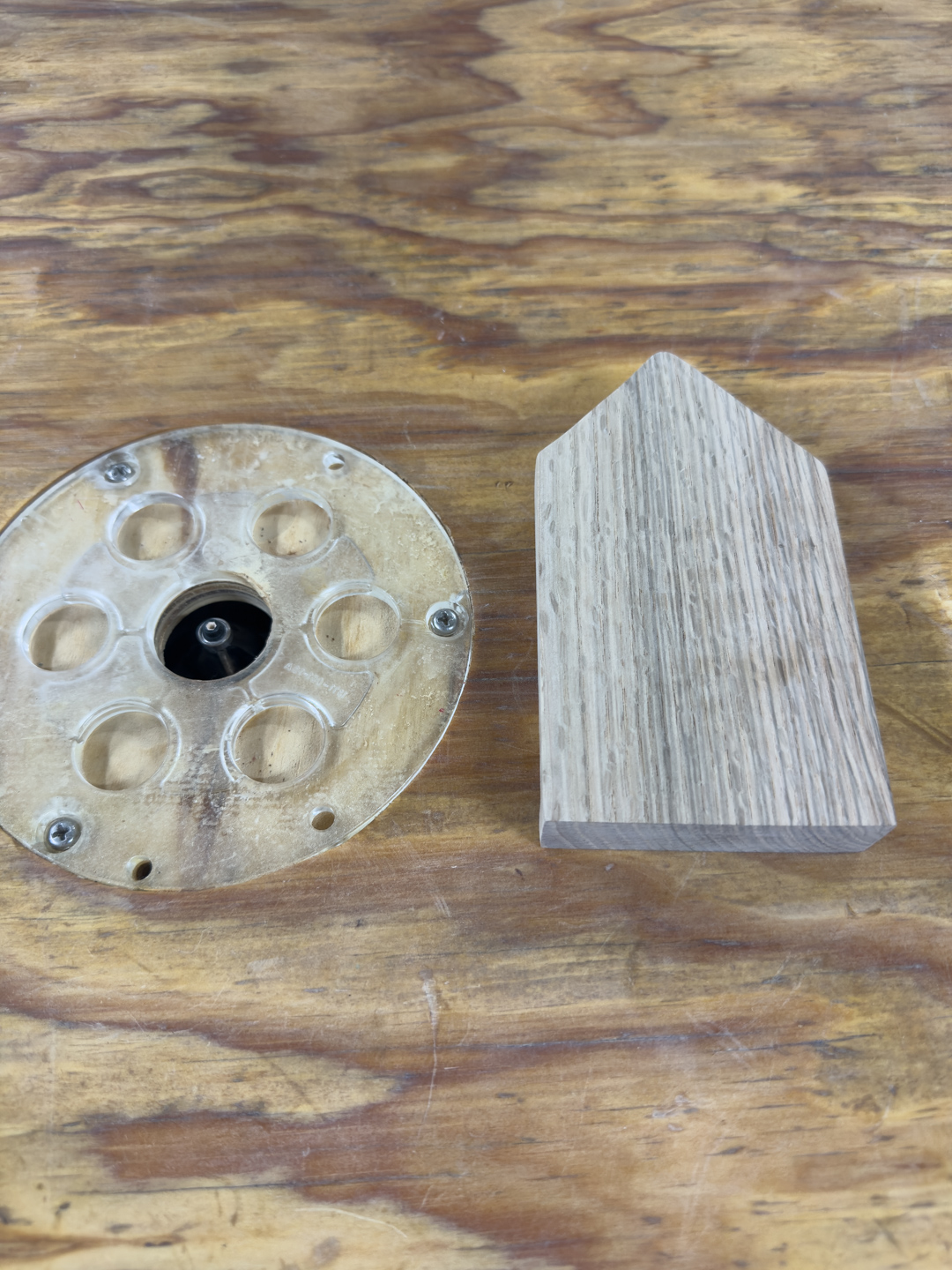
A router with a wooden template, the way we cut repeating shapes that have to match.
We build signs, displays, serving pieces, wall art, personalized gifts, and other woodwork with a purpose. Computer numerical control (CNC) carving, laser engraving, epoxy resin, and three-dimensional (3D) printing help us add the details that make a piece yours.
Each of those tools does a different job, and we choose the one that fits the piece. The CNC machine is for clean, repeatable shapes and recesses, the kind of cut you want the same on every side and the same on every piece in a set. It is the tool behind a matched pair of plaques or a row of coin holders that all fit. The 5.5-watt laser engraver is what puts a name, an icon, or a personal message onto a surface, fine enough to read a year later and clean enough to sit next to a hand-rubbed finish. Epoxy gives us color and depth, and it lets us set lettering into a piece rather than sitting on top of it. And the 3D printer is how we add custom lettering and small details that would be hard to cut by hand.
Most pieces use more than one of these together. A nameplate might start as a block of oak, get a recess cut into it by the CNC machine, take letters printed in 3D and set into layered epoxy, and finish with a personal message laser-engraved on the underside where only the owner will see it. The cedar reading holder we sell is built on the same idea, cedar boards joined and shaped by hand and machine, a laser for the name, and a finish that keeps it good for years of use. You can see both of those pieces on our Available Items page, and you can read the full story of the nameplate on our project page.
Our shop is private, and we arrange delivery or shipping with each order. You will not find a storefront address for a pickup, and that is by design. We keep the shop small, we make the piece, and we get it to you. You will find our current terms on the FAQ and policies page, including how delivery works, how we handle returns, and how we take payment. We do not run a shopping cart or an automated checkout. When you order, you are talking to us, and we send you written terms that set out the design, the price, the timing, and how the piece will reach you.
How a piece comes together
Every order starts with a conversation. You tell us what the piece is for, roughly how big it should be, any wood or color you have in mind, and the date you are working toward if there is one. A photo or a rough sketch helps a lot, and so does a budget range, because it lets us point you at the right build instead of the wrong one. We usually reply within one to three business days, and from there we work out the details together.
Before any money changes hands, we send written terms. Those terms name the design, the price, the build time, the payment terms, and how delivery or shipping will happen. That is not a formality. It is how both of us know we are building the same piece, and it is how you know what you are paying for and when it will be ready. Work begins after you approve the design and the written terms, and after any initial payment that we have agreed on for that order has cleared.
Most pieces take a few days to build. Larger pieces, or anything with layered epoxy, take longer, because each layer of resin has to harden before the next one goes in. We confirm the timing for your order in writing, and we are honest about it, which means the date we give you is a date we plan for, not a guess. If your piece is a rush, we will tell you what we can do and what we cannot, so you are not surprised.
The photos on this page and on our project pages show pieces we have already made. They are examples of the kind of work we do, not proof that a finished copy is waiting on a shelf. Every order is built for the person who ordered it, and because wood grain, resin patterns, and small handmade details change from piece to piece, your piece will be its own thing, even when it is the same design as one you see in a photo.
Choosing the wood and the finish
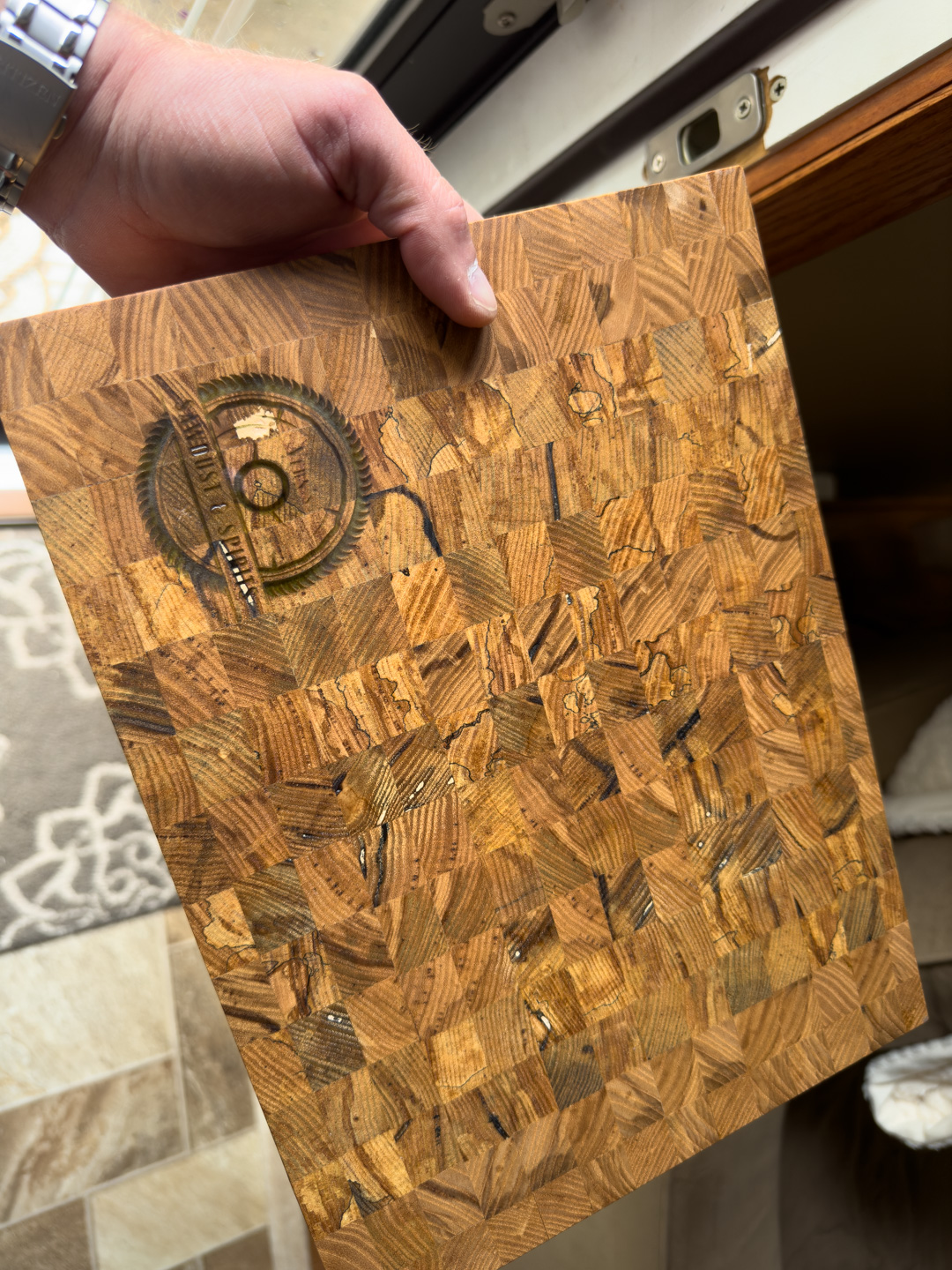
A finished cutting board, its grain and finish chosen for how it will be used.
Wood choice is the first decision on most pieces, and it changes everything that comes after. The color and the grain you see in a photo are not the whole story, because the board you get will not be the one in the picture, and that variation is part of what makes a handmade piece worth having. We match the wood to the job, and we will tell you honestly when a species or a finish is a better fit for the way a piece will be used.
For a cutting board or a serving piece that will see food and water, the wood and the finish have to stand up to that. End grain is a favorite for boards, because the grain faces up on the top surface, which is gentler on knife edges and shows off the pattern of the wood. The finish on a food piece matters more than it looks, and we use an oil and wax finish that you can refresh with your own hands, instead of a hard coating that seals the wood off from the way it is meant to be cared for. A piece that can be re-oiled at home is a piece that will last.
For a desk piece or a wall piece that will not see water, the finish is about protection and feel, and there the choices are wider. We keep the finish honest and repairable, the kind a piece can take a small nick and still come back from. We also think about where a piece will live, because a piece by a sunny window and a piece in a cool room need different care, and we tell you which one you have bought.
We source the lumber for each job ourselves, and we do not take customer-supplied lumber. That is a small thing, but it keeps the finished piece in our hands from the first cut, so we know the board, we know how it will move, and we can stand behind it. If you have a specific wood in mind, tell us, and we will find the board and tell you what it looks like before we start.
Caring for your piece
A piece that is cared for will outlast the person who ordered it, and most care is just a little attention at the right time. For an oil and wax finish, that means cleaning up spills promptly, wiping the piece down with a dry or slightly damp cloth, and re-oiling it now and then when the surface starts to look dry. You can buy a small tin of the same kind of finish we use and keep a piece good for years without ever taking it back to the shop.
For a piece with epoxy, the surface is harder and takes very little care. A wipe with a soft cloth and warm water is almost all it needs, and you should keep it out of prolonged soaking and away from harsh cleaners, because those will cloud the shine over time. Like any wood piece, it should not sit in direct heat or direct sun for long, and it should not go in a dishwasher. Those are the same rules that keep any good piece looking good, and they are in the care notes that come with your order, where the specific instructions for your piece control over anything general on this page.
Because wood moves with the seasons, you may notice a piece change a little as the air in the room dries out or fills up with moisture. That is normal, and it is why we build with that in mind. Small gaps and small shifts are the wood doing its job, not a fault in the build. If a piece arrives with a real problem, damaged in shipping or made incorrectly by us, that is on us, and our returns and problems page explains exactly how we handle it.
Making a piece your own
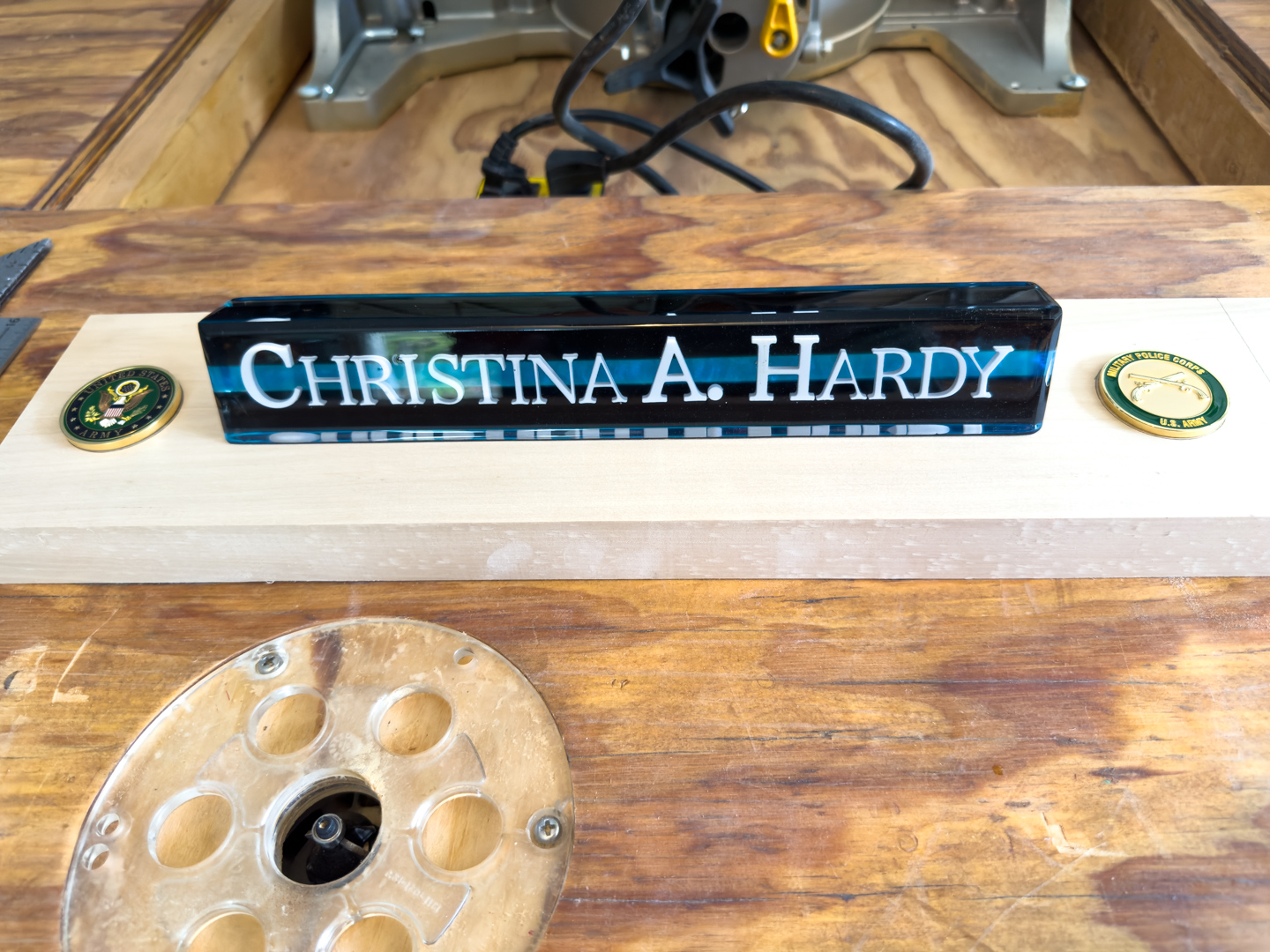
A nameplate in a wood base, with a pair of challenge coins set into the recesses.
Personalization is where a finished piece becomes a gift. A name, a set of initials, a small icon, or a message that only the owner will fully understand, any of these turn a piece of good woodwork into a piece that belongs to one person. We keep the details that matter, the spelling, the colors, the size, the exact message, and we confirm all of them in writing before we build, so the piece that arrives is the one you pictured.
For our cedar reading holder, personalization is a name or initials above the spots for a pen, a pair of glasses, and a cup of coffee. For our desk nameplate, it is a name set into the epoxy, a color you choose, a recess for challenge coins if you want them, and a message on the underside. Both are fully personalizable, and both are available to order even when we do not have a finished piece ready to ship, because we build to order and we confirm the build time before you pay.
When you are buying for someone else, the details that help us most are the things that make the piece about that person, their name, their initials, a date that matters, or a color that means something to them. Tell us what the piece is for and who it is for, and we will help you build a piece that fits the person and the place it will live. That is the kind of piece that gets used and kept, because it was built to be that person's piece, not a copy of someone else's.
Something for your home or someone you care about
Browse our made-to-order products, see how past projects came together, or tell us about an idea you've been carrying around.
Our made-to-order products are available to order even when we do not have a finished piece ready to ship. We confirm your build time before payment.